> ## Documentation Index
> Fetch the complete documentation index at: https://docs.vizra.ai/llms.txt
> Use this file to discover all available pages before exploring further.
# Reporting Runs
> Which surfaces push to Cloud, what's in the payload, and why a flaky uplink can never fail your build.
With [a key configured](/cloud/connect), a finished run is pushed to Cloud automatically.
There is no flag to remember and no separate cloud package — reporting is built into
`vizra/evals`.
## Which surfaces report
| Surface | Reports |
| ---------------------------------------------------------------- | --------- |
| `./vendor/bin/pest --evals` | Yes |
| `php artisan evals:run` | Yes |
| `php artisan evals:runner` (the [Run button](/cloud/triggering)) | Yes |
| `php artisan evals:run --dry-run` | **Never** |
| Any eval marked `->report(false)` | **Never** |
Dry runs are excluded deliberately: their numbers come from faked agents and would sit in
the history looking exactly like real ones.
## Reporting cannot change a run's outcome
A run that passed its gate passed it whether or not the network was up. So every failure in
the reporter is returned as a message to print, never thrown:
* One retry, because the common failure is a dropped connection.
* A `4xx` is never retried — sending the same rejected document again cannot start working.
* A failed push writes a line to stderr and nothing else.
A flaky uplink cannot turn a green build red, and reporting successfully cannot turn a
failed gate green.
**Failing runs are reported too**, before the test is failed. A run that got worse is the
one you most need in the dashboard — a history of only your successes would answer no
useful question.
## Excluding a wiring test
Evals that [fake the agent](/evals/testing-without-tokens) produce real-looking scores from
canned responses. Keep them out of the history:
```php theme={null}
expect(SupportBot::class)->toPassEval(fn ($eval) => $eval
->dataset(base_path('evals/support.jsonl'))
->report(false) // wiring test, not measurement
->assert(fn ($a) => $a->notEmpty())
);
```
From the CLI, `--no-report` does the same for one run. `--report` forces a warning when no
key is configured, which is useful in CI to catch a missing secret.
## What is sent
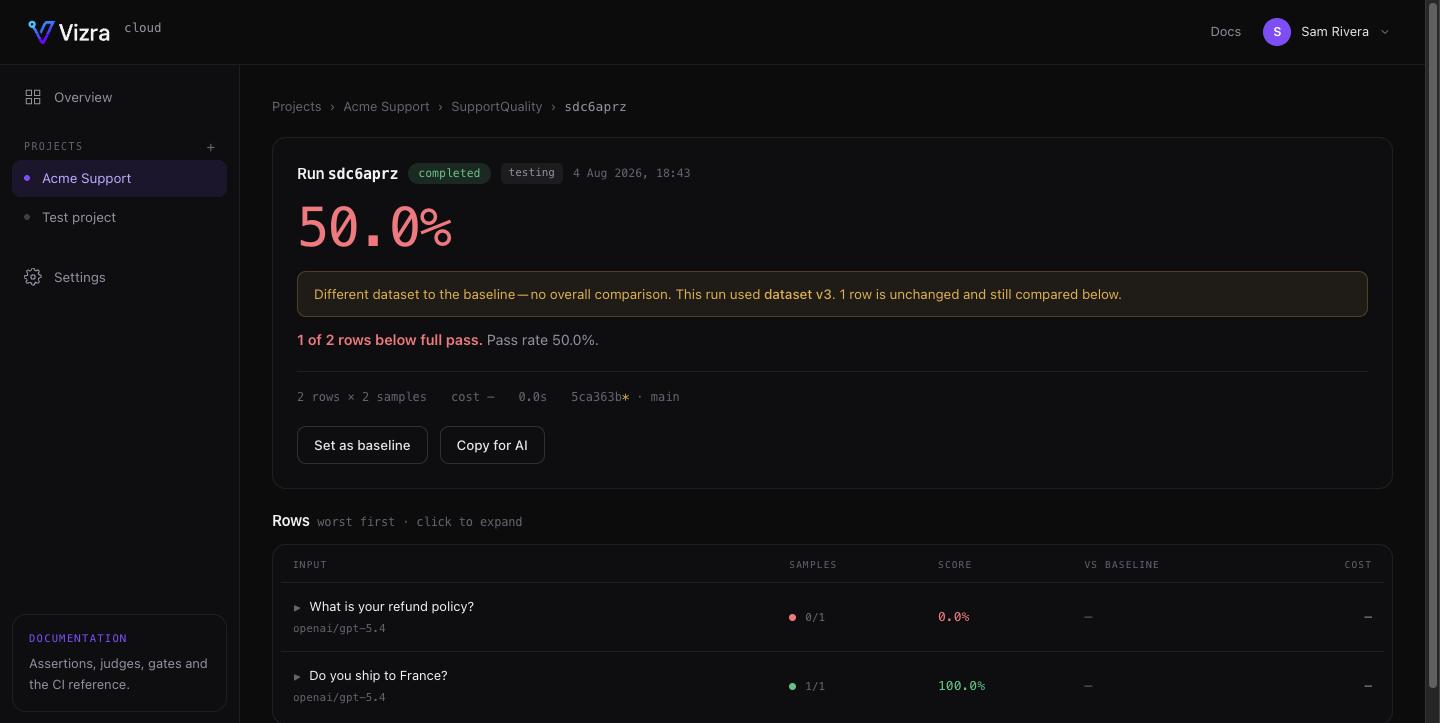
The run's metadata (suite, status, git sha, branch, timestamps, config snapshot), the
aggregate summary, every row's scores — and, unless you turn them off, the samples:
response text, structured output, tool calls, token usage, finish reason, cost, and every
assertion's expected/actual plus the judge's reasoning.
 ### Sending less
```bash .env theme={null}
VIZRA_CLOUD_SAMPLES=false
```
You keep scores, pass rates, trends and baselines. You lose the drill-down, the judge's
reasoning, **Copy for AI**, and [dataset editing](/cloud/datasets) — which derives from
reported samples and has nothing to work from without them.
Worth weighing honestly: the sample detail is both the bulk of the storage and the whole of
the compliance surface. If your eval inputs contain customer data, this is the switch.
## Environments
Runs are filed under an environment so a laptop run and a CI run are not the same number.
* Anything running in CI is `ci`, regardless of `APP_ENV` — CI boxes almost always set
`APP_ENV=testing`, and filing every CI run under "testing" would bucket them with
someone's local test run.
* Otherwise the app's environment is used.
* Override with `VIZRA_CLOUD_ENVIRONMENT`.
GitHub Actions, GitLab CI, CircleCI and Buildkite are detected automatically from the
variables they set, so each run carries its build URL, branch and pull-request number with
nothing to configure.
## Configuration
```php config/evals.php theme={null}
'cloud' => [
'endpoint' => env('VIZRA_CLOUD_ENDPOINT', 'https://vizra.ai/api/v1/runs'),
'key' => env('VIZRA_CLOUD_KEY'),
'samples' => env('VIZRA_CLOUD_SAMPLES', true),
'timeout' => env('VIZRA_CLOUD_TIMEOUT', 15),
'environment' => env('VIZRA_CLOUD_ENVIRONMENT'),
'auto_schedule' => env('VIZRA_CLOUD_AUTO_SCHEDULE', true),
],
```
`auto_schedule` is covered in [Running from the dashboard](/cloud/triggering).
### Sending less
```bash .env theme={null}
VIZRA_CLOUD_SAMPLES=false
```
You keep scores, pass rates, trends and baselines. You lose the drill-down, the judge's
reasoning, **Copy for AI**, and [dataset editing](/cloud/datasets) — which derives from
reported samples and has nothing to work from without them.
Worth weighing honestly: the sample detail is both the bulk of the storage and the whole of
the compliance surface. If your eval inputs contain customer data, this is the switch.
## Environments
Runs are filed under an environment so a laptop run and a CI run are not the same number.
* Anything running in CI is `ci`, regardless of `APP_ENV` — CI boxes almost always set
`APP_ENV=testing`, and filing every CI run under "testing" would bucket them with
someone's local test run.
* Otherwise the app's environment is used.
* Override with `VIZRA_CLOUD_ENVIRONMENT`.
GitHub Actions, GitLab CI, CircleCI and Buildkite are detected automatically from the
variables they set, so each run carries its build URL, branch and pull-request number with
nothing to configure.
## Configuration
```php config/evals.php theme={null}
'cloud' => [
'endpoint' => env('VIZRA_CLOUD_ENDPOINT', 'https://vizra.ai/api/v1/runs'),
'key' => env('VIZRA_CLOUD_KEY'),
'samples' => env('VIZRA_CLOUD_SAMPLES', true),
'timeout' => env('VIZRA_CLOUD_TIMEOUT', 15),
'environment' => env('VIZRA_CLOUD_ENVIRONMENT'),
'auto_schedule' => env('VIZRA_CLOUD_AUTO_SCHEDULE', true),
],
```
`auto_schedule` is covered in [Running from the dashboard](/cloud/triggering).